
Accessibility and Design: What iOS26 Reveals About the Future We’re Building—And Who We’re leaving Behind
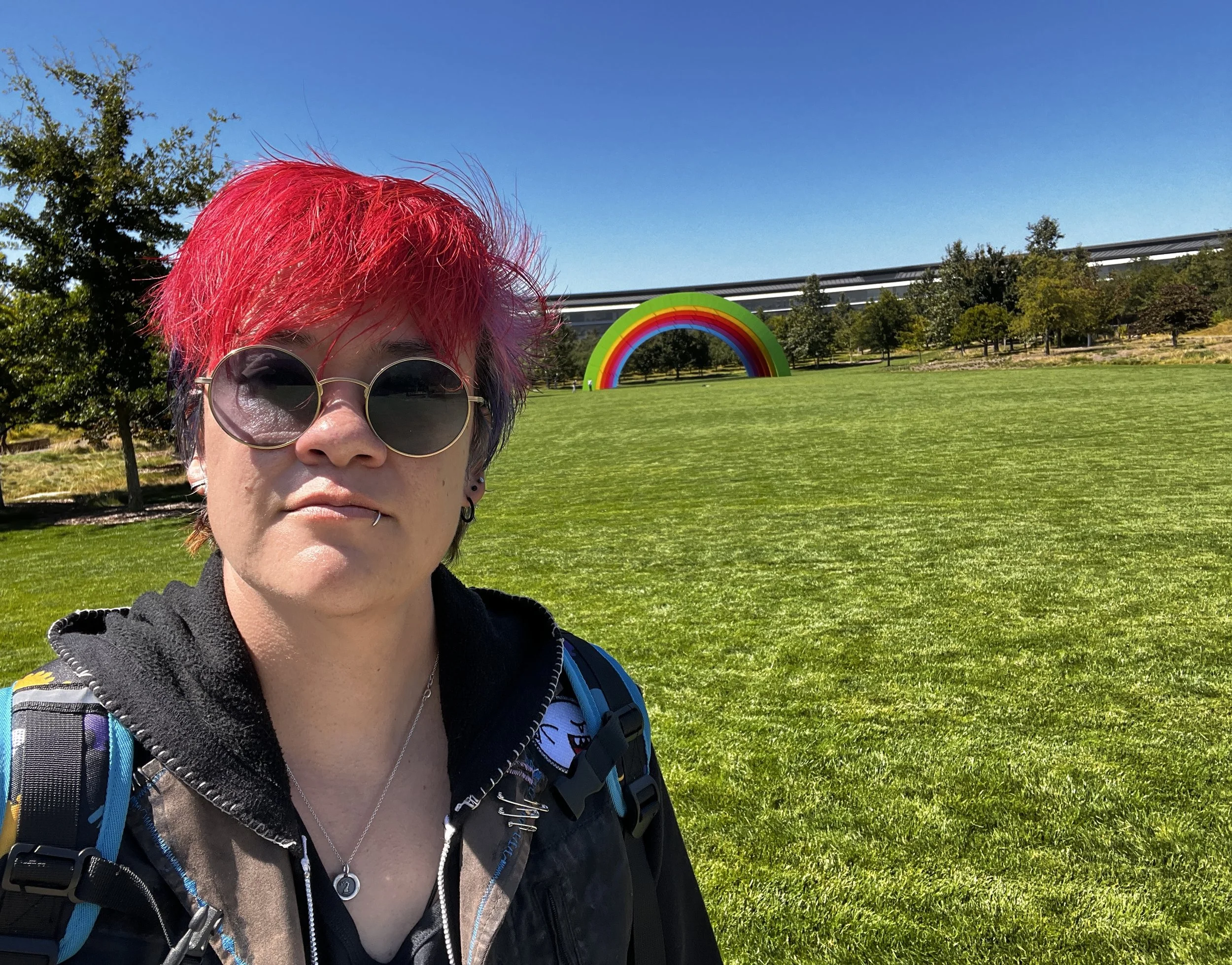
A rainbow for inclusion—Apple Park, Cupertino (2023)
Every product decision has consequences. I learned that the hard way—not just as an engineer, but as a patient and surviver.
Was there a single moment that changed your life, forever?
I have mine. I barely remember it—that’s how disorienting it was.
It’s something that happened and changed the entire course of my life. How I interacted with things. How I saw my best friend since high school. How I saw my parents. How I saw my body. How I saw the world. How the hell do I move on?
Truth is, it wasn’t a single moment. I don’t know if I could pinpoint it.
But I remember waking up—
Between the night before and that morning,
And knowing—
Something was wrong.
This event, or series of events, is why as a former quality assurance Apple employee, I was disgusted with their iOS26 update. More flashy cash grabs while leaving behind the communities that benefited from them the most.
“Liquid glass”—what the fuck does that even mean?
Before “The Moment”
Growing up, I gravitated towards Windows and Linux. I enjoyed the amount of freedom that was in the palm of my hand. But, the headache I had from showing my mom how to attach a file to an email for the hundredth time or trying to explain to my Korean grandmother how to use her new cellphone…
My basement dweller friends in college might have laughed about Apple fanboys, but I knew Apple put design at its forefront and it showed.
It showed up when my dad got my mom her very first iPhone and I didn’t have to show her how to send a photo. The only thing I had to do—open settings and make the font bigger.
That was it.
No tears. No screaming at me for not being patient with her.
One less thing to have to manage.
When my grandparents, aunts, and uncles came to me asking “you’re a techie, what should I get?” I knew my answer. The Apple ecosystem—it just works.
It wasn’t designed for me. It was designed for them. All of them.
The person who didn’t care about swapping out GPU’s, over-clocking, or running code to hack something.
It was designed for accessibility.
The ability to be accessible for all.
So when that moment happened… and what progressed afterwards… a nightmare…
I finally started to understand all the ways basic things were no longer designed for me.
But one thing was.
I switched over—
To the iPhone.
I was 24 years old.
I was only 24 years old when that moment happened.
Before that moment, things were exciting. Things were happening.
In high school, not only was I playing first violin in two symphonies, in all honors and AP classes, volunteering in special needs classrooms—I had cofounded our school’s robotics club. I spent almost every afternoon there with my best friend, Caleb. We entered into battlebot competitions and then SkillsUSA in Robotics and Automotive technology.
On our first try, we made it to nationals in Kansas City and won 7th place. It was amazing! With that competition, the district started funneling money into our school. Our school—the one that had meth raids in the snowbird houses across the street. We walked in a few months later to see new toys—a robotic arm, a gigantic 3D printer, pneumatics kits, new tools. It was a proper lab. A nerdy kid’s wet dream and our teacher, Mr. Carleton, had tears in his eyes. We went on to winning 3rd, to receive robotics scholarships, and with an in-state scholarship, I decided to go to Arizona State University.
I had dreams.
I had been so bored assembling grommets on the manufacturing line over the summer. Automate.
Automate, so people actually had time to enjoy doing what they actually wanted to do.
At ASU, I worked on a project called MSLED—a miniature submarine to take samples in Antartica. A year later, my dad started his masters in electrical engineering. We were already best friends. He had taught me how to shoot at age 8, we built and painted model airplanes and tanks together, and even built RC cars. In college, we studied and drank together with my friends. I took programming classes to my fellow EE classmate’s horror.
I also had a lot of doubts. I couldn’t see myself building circuits day in and day out on a computer. I had taken an evaluation and was able to skip courses to automatically go into 200 and 300 level drawing classes. Those classes helped me survive university but also had me sobbing to my dad—“I don’t think I want this!”
I had never told him about my high school geometry teacher telling me I wasn’t smart enough to be an engineer and was stealing men’s jobs. Or Caleb’s insistence women didn’t belong in tech, but don’t worry, “you’re not a girl.” The accumulation of hundreds of comments from them and my mother that lit the fire. Fuck you—I’ll prove you wrong.
At the same time, my dream of automation was crumbling. I had seen the Boston Dynamic’s robotic dogs and immediately knew I didn’t want to be apart of making that a reality. Anyone who knew anything about science fiction knew where that technology leads.
So with an affinity for breaking and fixing things, 6 months before graduating, I applied to a startup in Colorado as a product test engineer. When they asked if I knew anything about embedded systems, I said “not really, but I can enroll in a class today.” And I did. In the next 24 hours, I found the class, the professor, got a signature, and made an appointment with counseling.
Nothing stopped me.
“Your gift—is determination.
That’s why you’d make an amazing engineer.”
My dad had told me one night.
In the end, I had graduated on the same day as my dad, in the same field.
But just a year later, I found myself in San Francisco—away from the mountains, the woods, everything I thought defined me. A city I swore I’d never live in, with a sister I barely knew, far away from anywhere I dreamt I’d be.
What’s more—
I got “laid off.” Really, I knew, I got fired.
I got fired because I told “HR” (the founder’s ex-military brother) at SKULLY, a heads-up motorcycle helmet, SF-based company, it was inhumane to treat our Indian consultant the way we did. I was disgusted by my new manager (mine had rage-quit). Spotting the consultant wearily walking back to the office, he was laughing, “he won’t last another month!” The consultant had been sleeping there for the last few months. He was lucky if he only got a few hours of sleep. I got fired because I insisted I work on manufacturing, audio, or anything related to what I was hired to do. Instead, they put their only “girl” engineer on inventory. After a few weeks, I plopped down and started working on the audio codec and wouldn’t budge.
They didn’t like either of those things—
“We aren’t here to be nice or to teach you things—we’re here to build a product.”
The moment happened a month later.
I had interviews lined up.
I was ready.
In fact, I had an interview with Flex (formerly Flextronics) as an R&D lead after they were impressed while working with me at SKULLY.
Sure, I was vomiting daily from stress. An affliction that started plaguing me in college, stopped in Colorado, and continued back up working manufacturing hours plus the additional hours the SKULLY founder demanded.
“You have to be here at 10-11PM because that’s when all our important decisions are being made.”
The bullshit they slung.
The shit you put up with when you’re young and want to work on something “cool.”
Looking back, it was such a shitty design. SKULLY went bankrupt and were sued for inappropriate use of seed funds—cocaine, new Dodge Vipers, and strip clubs.
So I had ignored the vomiting. I ignored what the doctors told me to do—avoid kimchi.
I’m Korean—fat chance.
You vomit. You keep going.
No room for weakness.
Just hit the goal and move on to the next thing.
The Moment
The night before the moment was an ordinary night. I had working on some practice programing logic problems, played league of legends with my friends, and went to bed.
I woke up the next morning unable to stand up. Everything was spinning. I kept vomiting. I couldn’t get out of bed for 3 days straight. I didn’t even have health insurance. I went to the clinic, barely able to stand up, let alone walk.
As I walked there, I stopped.
I couldn’t hear anything—
Not one thing out of my right ear—
Just ringing.
At the clinic, they told me “it’s definitely not an ear infection.” But they sent me off with ear drops, just in case.
I asked my parents to put me on their insurance—
They declined.
The Affordable Care Act, allowing you to insure your children up to age 26, was passed by Obama.
My parents hated, hated Obama.
“You’ll recover and find something soon. You always figure something out and if we help you, you’ll be dependent on our support. But you’re always welcome to move back home.” That scared me and I didn’t remember why.
So I didn’t get insurance. I didn’t get San Francisco government healthcare. That was for other people. People who didn’t work hard enough.
I didn’t even file for unemployment. That would be shameful.
I was at the same time, incredibly cocky and full of myself and incredibly insecure.
I believed in hard work. Not government handouts.
So I continued to go through interviews. Failing one after the next. I bought myself a cane. Mustered to dizzyingly put one foot in front of the other and walk to interviews, vomiting along the way… only to not be able to hear.
I bombed the Flex R&D onsite interview.
In 6 months, I just about maxed out my credit cards. I couldn’t tell my dad. The only lesson he had given me—don’t be stupid and pay them off completely at the end of the month. I was drowning.
I was now one month away from being unable to pay rent.
I could not go home.
If you’ve read my post, “Avoidance”, you know why.
But I didn’t remember all of that yet.
In fact, I barely remembered what happened in the last few hours. I carried a notebook. Notes on everything so I never had to remember.
At the last moment, I finally got a job as a test engineer at a traffic-monitoring company, Sensys Networks.
By this time, I was still walking with a cane, vomiting daily, unable to sleep from tinnitus ringing relentlessly, and no improvement to my hearing. My violin sat in the corner covered in dust. My skateboard stuffed in the closet.
The Aftermath
Soon, I found out, I couldn’t sit in front of the computer like I used to.
I started having attacks. Vertigo attacks. They’d last for a couple hours where everything was spinning accompanied by vomiting spells.
And my hiring manager thought I’d get bored. Ha ha ha.
A couple months later when insurance kicked in, I rushed to Otolaryngology and did all the tests. I did hearing tests, balancing tests, eye movement tests, you name it.
I was diagnosed with atypical Meniere’s disease. A disease featuring unilateral hearing loss, tinnitus, and vertigo attacks.
I was beyond devastated.
The temptation to jab something, anything in my ear to get the ringing to stop…
I missed silence.
God, I miss silence.
And as I’m grieving from loss, unable to sleep, unable to concentrate, unable to skateboard, unable to play my violin—the only thing that helped me really process emotions…
I get a text from my mom—
At work.
Not—
“Hey honey, how are you holding up?”
But—
“What do you think of these shoes?”
Goddamn shoes.
Here I am—struggling to carry groceries with a cane. Struggling to open doors, struggling not to throw up on the Muni or in a car. Struggling to walk up a slight incline when I used to run up and down mountains. Here I was, jumping when people approach me unable to hear people behind me. Unable to enjoy music. Unable to follow conversations. Unable to get a hearing aid because I didn’t have the right kind of hearing loss. No longer able to enjoy nights out for a couple beers with friends. Here I was barely able to process the last 6 months.
Suddenly, I was in a world not designed for someone like me.
It’s isolating.
And my parents… as if there was zero concern.
No help.
No help with insurance or money.
Not even emotional support.
Not even from my dad.
Just shoes.
Another pair in the bedroom-size closet of shoes.
Half the size of my apartment.
I didn’t answer that text.
Nor her following text about more shoes.
Nor her rapid fire followups demanding why I wasn’t answering.
That night, when I answered my dad’s phone call, it wasn’t—
“Hey, we didn’t hear from you. Are you alright?”
It was—
“You’re a shit child—how dare you!
Your mother does everything for you and you can’t even bother to send a text.”
Then they both proceeded to scream at me for hours while I vomited and collapsed in a puddle of my dog’s urine.
I was invisible in my worst moment.
I knew what type of mother I had.
Now, I knew what type of father I actually had.
You learn who someone truly is by how they treat those they no longer find useful.
I wasn’t doing my job—
Pacifying my mother.
When you’re no longer able-bodied, you realize how many assumptions are made about you.
Does that person have a vestibular disease or are they drunk at 8AM on the Muni?
How many of these people we see were left behind by a system not designed for people like us?
I was a single paycheck away from not being able to afford rent.
I couldn’t work.
And I was taught, “Only lazy people accept government handouts.”
I tried explaining my confusing thoughts on government aid to my best friend. “They’re not like you. You are an outlier. You actually work hard so you’ll be ok. These people, accepting handouts—our money—they’re lazy. They’re not like you. I can’t believe you’re falling for this leftist propaganda.”
But what if I don’t get better? What if I lose my other ear? I’m so tired! I’m so sad! What if something happens and I can’t pay off my credit cards? What if I end up homeless?
So yes, that moment that robbed me of my balance and hearing, also made me realize the truth about my parents and my best friend, the world I grew up in—
We only accept able-bodied people.
The next two years while at Sensys Networks, I became suicidal. I was hospitalized and diagnosed with PTSD. I lost my college best friend to a gun related death after coming back home immediately following hospitalization. RIP Justin. I lost my dog shortly after. I lost my relationship with my dad trying to cut ties with my mom.
I found who unconditionally loved and believed in me—
My sister and my SF chosen family.
Design at Apple
And just about 8 months after hospitalization, on shiny new antidepressants, I joined Apple in Security Engineering and Architecture Quality Assurance at headquarters.
As much as I was proud I was there, being on new meds while starting a dreamy job, is no walk in the park. On several occasions, I had to discretely ask my manager if I could go home after soiling my pants. Both embarrassing and an hour-half Uber ride home.
In working to maintain many UI automated tests, I became very familiar with the Accessibility team who developed many of the tools needed for VoiceOver. The same tools needed in my tests. Their team was also right next to our section, so I saw people like me, with disabilities, every day.
The iOS hearing features helped me every day. I was excited when they released the feature allowing me to put my phone in the middle of a conference room, or closest to whomever was speaking, and use the EarPods as a hearing aid.
I joined the Accessibility DNA (Diversity Network Association) and then their leadership board. I started monthly silent lunches to learn and practice sign language. I helped organize events and bring on speakers like Temple Grandin in to speak on Accessibility and the value of thinking differently. We held events so developers could learn how Accessibility features worked and how to design for accessibility.
Here I found people designing for all the things I had been raging about as a disabled person. Here I learned how to design for accessibility—for inclusion.
I became familiar with what I could ask for in order to help me manage my disease and PTSD while working. Things that improved my workflow. But Apple had new goals, five and a half years and three managers later, my job was disappearing and I was given the choice— a few months to apply within Apple or, after that time, leave.
I was a couple years into transitioning. I was questioning what actually resonated with me and my values. I was feeling physically significantly better—mentally and physically.
So I left.
The Update
I backpacked Europe. I hiked 500 miles on the Appalachian Trail—
Things I thought I’d never be able to do with my disabilities.
I wish 24-year-old me could see me now.
Now, I’m studying Spanish in Spain.
But a few weeks ago, in the morning, I turned on my phone after a new update.
Within 5 minutes, I was nauseous and vomiting.
I had gone so long without any problems.
The screen, on the lowest brightness setting—too bright.
All the App icons now had a floating glow about them.
Every time my phone unlocked, the transparent motion transition sent my eyes reeling.
Every transition, between taking screenshots to swiping between apps, made me dizzy.
I immediately navigated to the Accessibility features—Motion and Display and Text—and started turning things off.
Now, I get a black screen or an opaque box in my transitions and my phone is still barely useable.
It left me wondering—did they even consult their Accessibility and Quality Assurance teams or did they just not care?
How many people have they isolated—
Just for a gimmick?
What Accessibility and Inclusion Means
I share my story because disability can happen in an instant.
It can change your life—your whole world.
It can take years and sometimes, you never recover.
Are you willing to be forgotten?
If my grandmother was alive today, how would she be coping?
My mother, who suffers from migraines—has she thrown out her iPhone by now?
(Though…maybe not a bad thing.)
But globally, migraines are the third most common disease affecting 14% of the population, majority of which, are women. That’s 1.6 billion people who may no longer be able to use their phones (if they have an iPhone) while having an attack. And potentially, even a significant amount of those people, who may have induced migraine attacks caused by their iPhone.
Over 35% of U.S. adults aged 40 and over (around 69 million) suffer from vestibular disorders.
Women are 2 to 3 times more likely to have a vestibular disorder than men.
Once again, showing we are making design choices that exclude half of the global population.
Meniere’s disease can effect people of all ages but is likely to occur between the ages of 40 and 60. Within a year of my diagnosis, I had friend’s parents telling me how they had been diagnosed with the same disease and how badly it has effected their quality of life.
When 40 is the new 30, how many people are we willing to forget?
And sensory sensitivity isn’t rare—it’s a core trait of neurodivergent people. I spent hundreds of hours in special needs classrooms as a volunteer throughout school and college. The amount of testimonials from parents overjoyed that they can now understand their disabled child with the help of smartphones and tablets. Or even at Apple, non-verbal people with autism now are able to program to create apps that help others like them to communicate. Offer different perspectives, have a voice, and join their community. My friends with ADHD and ASD—they have sensory sensitivity as well.
As I was venting in my instagram story about this iOS26 update, I received several messages all along the same vein—
“This whole glass crap is making dark mode pointless, hurts my eyes all the same.”
Apple built its reputation on telling everyone—young and old—“Don’t worry, it’s expensive but it’s worth it. We’re bring you along with us—into the future.” Their designs were sleek enough to appeal to the next generation, yet intuitive enough for grandparents. That’s what made it powerful.
The same company that helped me hear again across a conference table has now turned my phone into a vertigo trigger. How do you go from designing for the disabled to a disabling design?
“Liquid glass”—
What is the vision here?
A Star Trek-esque glass see-through tablet that can overlay on top of “augmented reality”?
To prepare customers for that future?
What of privacy? What of haptic feedback?
What of the 70% of people—
Who have reported they experience “cyber-sickness”—
Dizziness during and even prolonged vertigo after experiencing VR?
Believe me, I understand designing for the coolness factor. I understand the importance of R&D as well as human integration.
But sometimes—the majority of the time—we must design for accessible human use.
We have to slow down and think about the person with an arm full of groceries, the parents with a stroller, the grandparents with a cane.
We have to think about those with colorblindness, hearing loss, visual impairments, and vestibular disabilities.
We have to think about the length of our thumbs in order to press that goddamn small button at the bottom of the screen to open the menu to switch between tabs or even to select the address bar to type a different URL.
If we let automation and AI reshape testing, user experience, interface design, we’ll miss the mark every time.
Intelligent design is understanding the person using the device.
You have to think about how big or small a person’s hands are and their gestures as they move across the device. What feels natural? Or what’s the point?
What’s the point in all that cost of designing and manufacturing and effort if no one is going to use it?
SKULLY was bound to fail.
Even if they were successful in getting their manufacturing up and running—
They would have failed.
Why?
Because no one wants to be in a motorcycle accident, survive, and walk away only to lose an eye because the optical stack got lodged in their eye. Even if they nailed the heads-up display technology, no one wants to be in an accident because their map or a text popped up, just an inch away from their eye, impeded their vision.
Some things are sick and so amazing to dream about.
But we also have to be realistic about human limitations.
We have to be conscious about where we choose to put our energy.
I can dream about VR.
About running through a field
Wielding a gigantic broad sword—
Slaying demons
or
Bobsledding down glaciers,
Through hoops—
Sonic the Hedgehog on ice.
But there’s something so thrillingly alive seeing Godafoss,
The waterfall of the gods—
In person.
Witnessing trolls hiding in their mountains—
Without the fatigue of stiff, unused, neglected muscles.
A VR headset costs somewhere between $400 to $3499 for Apple’s Vision Pro.
If the Vision Pro and “liquid glass” feature is a preview of the future, we’re hurtling towards a reality designed only for those who can stomach constant motion.
A flight to Iceland? $700 round trip from SFO. That’s Christmas Eve prices.
At some point, it feels like Silicon Valley has forgotten who they’re designing for.
Or maybe they knew all along.
I was just ignorant to it.
But I want human-centered design.
Not for the fastest, or the richest, or the newest to keep investors happy.
I want to design and engineer and create for the actual human holding the device—
In all their limitations.
Giving yourself limits is where innovation happens.
So we must ask ourselves—as designers, as engineers, as consumers—what vision do we want? What future? Do we accept another version of a two year, obsolete life-cycle product that isolates the very people we love?
I thought the whole point was to create tools we could use to connect to each other—to make our lives better?
To call granny up, see her face, and have her show you the yukgaejung soup you could almost smell across the hundreds of miles while you shared with her your view scaling Long’s Peak—a 14,000 foot mountain giant.
A Bridge. A Tool.
At the end of the day, that device in your pocket should be a bridge.
Not a wall.
Not a weapon.
Not a source of nausea.
A tool—
One that helps us reach each other.
I don’t know. Maybe I’m not dreaming big enough. Maybe, I’m bitter I might be left behind.
Maybe I’ll become like my mother screaming at my child to stop rubbing the shit of the future in my face.
But as I sit here, typing on Christmas Eve in the Costa del Sol of Spain—
Where kids and elders interact with each other daily. Where random people come up and talk to me on the street. Where we can spend 2 hours outside chatting with coffee or wine…
It’s hard not to compare that with the hundreds of hours I spent growing up, in the same room as my friends, staring at a screen and them getting angry I hadn’t perfected my jungling in League of Legends.
I’m sill figuring this out. I loved those digital worlds. Sometimes, I still do. I love creating. I love world building. I love exploring worlds. But I’m trying to rewire how I find joy from synthetic highs to somatic embodied presence. It’s a work in progress.
At the end of the day, technology is just a tool. Not a life.
And a tool that stabs you every time you use it—
Isn’t innovation—
It’s a shitty tool.
So next time you’re designing something—ask.
Ask for the diverse perspective.
Ask for the disabled users perspectives.
Demand inclusion before the release.
I can’t believe I’m sitting here on Christmas Eve writing about Apple…
Merry Christmas, Happy Holidays, and have a magical New Year.
The views expressed here are my own. I speak from personal experience as a disabled user and former QA engineer committed to accessible design. I hold deep respect for the engineers and teams at Apple who shaped my career.