
The Sacred Mess: Semana Santa and the Myth of Holiness
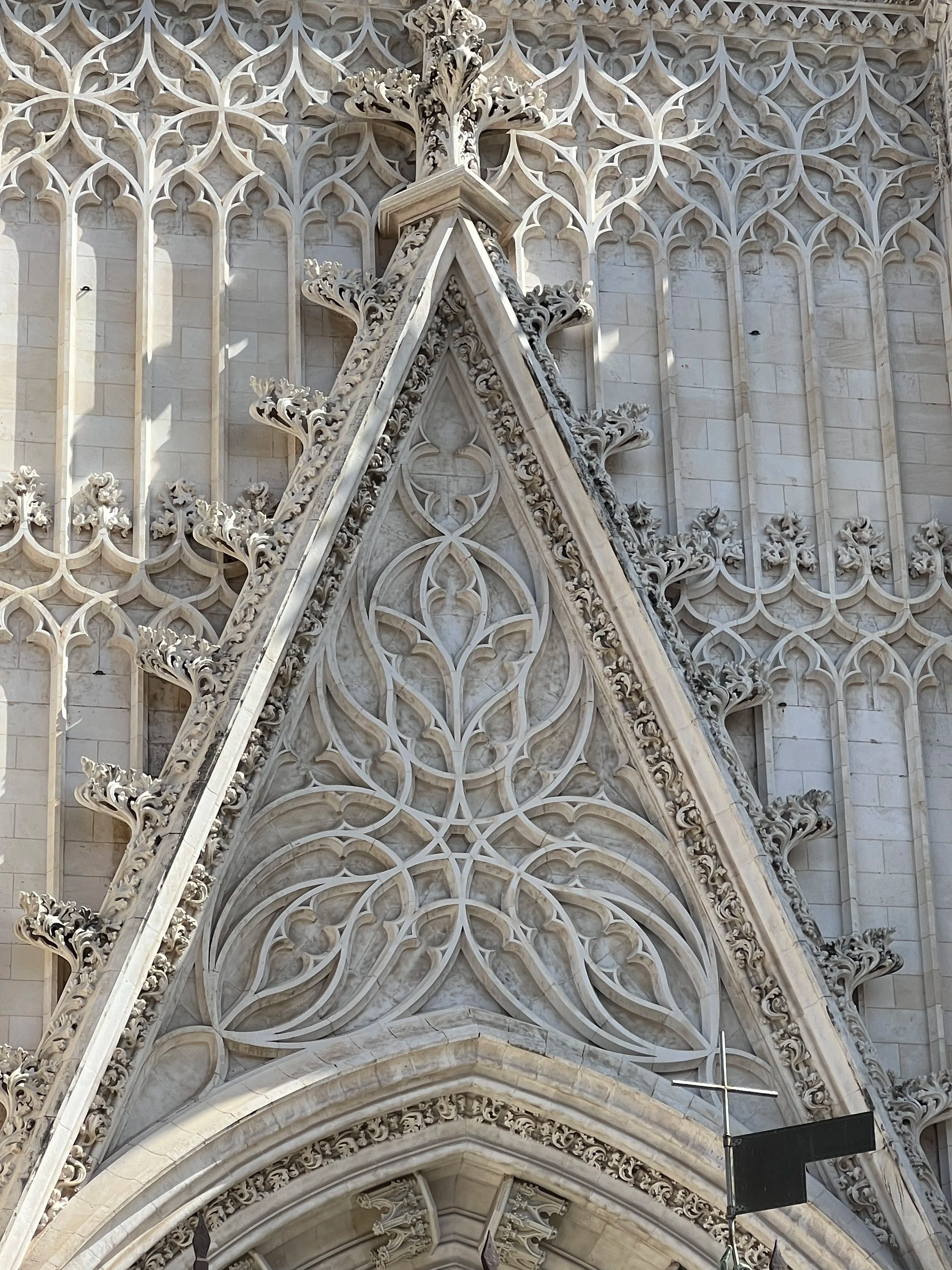
Church of Seville originally the Great Mosque Mezquita Mayor. (2025)
What we call “sacred” is often constructed, inherited, and enforced—not universal truth.
6:00 AM—the incessant clashing of bells begin. Pip startles awake. Jumps from the bed, pacing whining, and starts howling in a matter of seconds. The bells pause for five minutes.
6:15—The bells start up again into a clashing roar. I hold Pip close as he tries to wiggle away and howl again.
6:30, 6:45, 7:00… each with only five minute gaps of silence. A blaring cry to the town, a persistent, unavoidable reminder, today is the first day of Holy Week, Semana Santa—Palm Sunday.
As I laid there, I contemplated what to do. I wasn’t going back to sleep. Maybe, I too should begin the week in a meditative Om chant as the bells rang but that was quickly abandoned as I sat up. Annoyance, dizziness, tiredness, and a heavy churn of my stomach after yesterday’s ungodly… godly?… all day feasting rushed to the forefront.
Yesterday, I ate en mass. No idea what overcame me. I ate my standard breakfast—3 eggs and 2 slices of toast—went to the gym with a friend and afterwards ate:
A sandwich mixto con tomate (ham and cheese sandwich with tomato)
A mango salad with avocado
Tuna with peas and potatoes
A slice of pistachio cake
A protein shake
A banana
An entire bag of Takis
An Apple
A large bowl of chickpea pasta with cheese
An entire bag of Haribo mixed gummies
Why do people say it’s an ungodly amount of food? The imagery of gods gorging at a banquet is imagery as old as the gods themselves. Spillage of grapes and pomegranates out of cornucopias next to entire boars and overflowing cups of wine. Though, I suppose there are some gods, one immediately comes to mind, incredibly insecure gods, who demand everything while starving everyone else in the name of discipline—to be worthy of love.
My mind ran through these thoughts and the thoughts of holiness, worthiness, and cleanliness, as I hugged Pippin as he cried with the clashing of the continuous galling bells.
Never mind yesterday’s desire to stuff anything and everything I found in the pantry and fridge in my mouth—being sick and then doing a couple days of intense work outs will do that to you—no, my thoughts have been on shared overlap of the Christian and Zen Buddhist’s belief in cleanliness intertwined with holiness. The notion, to me, is both laughable, hostile, and downright uncongenial. “Cleanliness is next to godliness.” Famously popularized by Methodist founder John Wesley. A phrase that makes me visibly annoyed. As I’ve been continuing my practice in meditation, breath work, and yoga, particularly Zen Buddhist videos have been frequenting my Youtube “For You” page with titles like, “Why Cleaning Matters More Than Mediation”, “How Cleaning Heals the Soul”, and “Your Messy Room Reflects Your Mind.” Yes, even the Buddhists can have click-bait titles. Each one reminding me of the repetitive, shrill reminder parroted in churches, “Cleanliness is next to godliness!” At the start of Holy Week, this is one of the things I want to examine.
I suppose I am sensitive to my own “shortcomings” as I scan my apartment, gazing up from my phone’s Youtube page. But, fundamentally, it’s something I’ve stopped believing as well as something I’ve been trying not to judge myself too critically about.
Why?
It’s a performance. And it carries harmful rhetoric. Especially when it comes from a place of judgement. Whether external or internal.
I’m not talking about the basic level of cleaning needed to maintain hygiene, health, and the running of a household. This isn’t what I’m focused on. I believe the mind reflects its environment. With the convenience of homes, we stick ourselves in boxes and it’s easy for our minds to form rigidness around those boxes. What aught to be and what’s not right. Not correct. When you conflate goodness with cleanliness, an obsessive, ridged mindset starts to form similar to what you see in depressed, caged birds—an unnatural mindset.
Today, I am a person who, when I walk into an intolerably clean “home”, I immediately have a desire to pick up the closest, breakable thing and smash it to the ground. Not out of disrespect, but the state feels so unnatural to me, the need for an element of chaos begs to be introduced. Fortunately, I’ve never indulged these desires. Not in my own home and not in anyone else’s.
But, I remember a time in my life where this obsession for correctness took over my life. The beads around my wrist, once used as a gentle reminder to come back to the present, became a counting curse. If I wipe the sink this many times, rub the handle, clean the floors… everything will be… ok. “If I clean every day, I will be ready for friends to come over.” Only for a home to never be ready to receive guests. “If I clean every day, I will clear my mind.” Only to then begin fixating on the tiny dry hairs easily removed from our own bodies, taking tweezers as we start plucking hairs away onto a tissue. Absolute thinking. Purity thinking infects the mind as my judgements and expectations ridiculed me. With the overwhelm of anxiety, the mediation beads become numbers 101, 102, 103,…, 108, 1, 2, 3… 108… now a source of fixation to grasp at any source of semblance of control within my own life.
Layered into this purity call is the cage it surrounds our women and children in. The “domestics.” Women not only have to compete within their workforce just to be taken seriously, but conditioned with expectations to manage the blunt of household chores, and manage the emotions of everyone in their household as well. I grew up in an incredibly conservative, evangelical Christian Korean American household. The men were served first. My own grandfather, my mother’s father, would become outraged if he sat down and food didn’t magically appear and god forbid, someone touched their food before he swallowed his first spoonful. My father was an engineer and my mom a teacher and by the time I was around 8 or 9, they bought an acre lot in a gated community to build their dream home on next to the farm lands in Arizona. The one-story house was huge for the four of us.
At first, it was exciting. A 10-foot deep pool, my own bathroom…my dad bought a ski boat for his 6 car garage. “God has blessed us”, chimed my parents, “we gave more than 10% offering, we saved, we have been chosen by God, and God has blessed our efforts.” But as years went by, the house to me felt more like a trap than a blessing. My mother became increasingly irritated and overworked. The entire weekend was spent cleaning the house. The house did nothing but magnify problems. My mother believed cleanliness was next to holiness and it showed—Two hours getting ready to be presentable, not a hair out of place, and magazines set out everyday, not for leisure, but to display a forever model-home feel.
Underneath, it ate away at her… and at us. She’d scrub and scrub until her fingers and nails cracked and bled. My sister and I watched in horror as she lined us up in front of her, a judgey finger slowly pressing hard, squeaking against the surface and as she inspected the micro dust on her fingertips insisting we hadn’t cleaned and lacked discipline. If cleanliness is next to godliness, it is only to demonstrate the immense fear of the realization you will never live up to expectations. Little by little, you become convinced of your own sinful nature, driven by external expectations you don’t even fully understand. Laughter and joy cease and are covered by a layer of shame and the filth of lies you can’t keep track of as you become consumed by the desire to be accepted, held, and loved.
It is impossible to keep a clean house when you have children. It is impossible to keep a clean house when your ‘partner’ doesn’t believe in “doing the domestics.” It is impossible to keep a clean house when you have chronic illnesses. It is impossible to keep a clean house when you brain works best in a constant state of clutter. It is impossible to keep a clean house when corporations demand so much of our time and energy seeping into our living spaces. Many times, it’s impossible to keep a clean house even when you have enough disposable income for cleaning services. It’s impossible to keep a clean house… what even is clean?
I am unable and now, unwilling to subscribe to an idealistic mantra that has caged so many—cleaning fixes your cluttered/unworthy mind and will bring you closer to holiness/divinity/spiritual awakening. Slavery is proof what may be a tool for some, can be a prison for others and one should not be forced to use tools that keep themselves prisoners. Tools should not be heavy gates barring paths for enlightenment… or acceptance. I do not use meditation beads because I know myself. I know I am capable of imprisoning my own mind. I do not clean daily, even sometimes weeks in-between whether busy or fatigued because a stroll outside noticing flowers will do more wonders to my wellbeing than the harshness of cleaning products worrying about should’s. I do not shower daily. My skin is finally clear and I’ve discovered my hair curls in waves… but best of all, I don’t spend my mornings having 15 minute showers having ruminative, anxiety induced, future conversations. But it begs the question… how much of cleanliness equates holiness was designed to keep indigenous and people of color separate and unholy?
We are surrounded by nature. Even the metal and plastics we have formed were extracted from natural materials. Nature is beautiful, awe inspiring, fascinatingly magnificent and terrifying yet there is nothing perfect. We look at flowers with such awe, as blessings, as rituals for offerings, yet a flower is not perfect. It has dried petals, wilted leaves, casting off dried leaves as it grows just as a gecko sheds his skin. Yet no one questions a flower’s divinity. Nature is governed by the laws of ‘eh, it’s good enough’ and it works astoundingly beautifully. It leaves room for play, for joy, for growth, and never tries or claims to be perfect… though, I’ve never talked to flowers but I’m sure plenty of cats claim perfection licking their assholes. I believe in these imperfections. In the balance of stillness and chaos—things become imperfectly perfect. I believe we are made up of every living thing just as drops of rainwater carry our DNA. In this, we are One.
I believe whether it’s using AI or a glove to clean, not every tool was designed for everyone. What good is a glove to an amputee missing their hand? Or to someone with a latex allergy? What good are meditation beads or church bells chiming for mass to someone who isn’t catholic? So we have to be careful in understanding the usefulness of catchy phrases that turn tools of humbleness, discipline, cleanliness, and orderliness into rigid barriers that deny ourselves and others towards growth whether spiritual or societal. In the realm of human spiritual pursuit, a person serving in a monastery breathes the same breath as one who splatters paint across a surface and creates from chaos. The methods and tools may be different—but the questions behind the breath remain the same.
Feliz Semana Santa!